Vocabulary/Concept Vitalizer:
Normal

Valle and Connor relay the origin of "normal" (p. 44). Webster's dictionary had many definitions for "normal" These were a few that I believed pertained to our topic of inclusion;
Definition of NORMAL
adj \ˈnȯr-məl\
1 a : according with, constituting, or not deviating from a norm, rule, or principle b : conforming to a type, standard, or regular pattern
2 a : of, relating to, or characterized by average intelligence or development b : free from mental disorder : sane
John Perry, a professor at Stanford's philosphy department and an on air talk show co-host from Philosphy Talk states on his blog, " What is Normal?" (2010) ;
"It seems that there is nothing very normative about being typical, regular, usual and ordinary; but conforming to a type or standard seems like something one ought to do. We set standards, live up to standards or fail to do so, and the like."
http://theblog.philosophytalk.org/2010/03/what-is-normal.html
Valle and Connor use the terms, "Discourse of Disability" (p. 60) and "myth of homogeniety" (p. 52). I am unfamiliar with these terms. I thought I would look further into their meanings.
http://theblog.philosophytalk.org/2010/03/what-is-normal.html
Valle and Connor discuss these next two words, mainstreaming and inclusion, throughout the text. Inclusion was "understood to be an updated term for mainstreaming rather than a significantly different philosophical orientation." (p. 57) These are Webster Dictionary's current definitions;
Definition of MAINSTREAM
verb \ˈmān-ˈstrēm\
transitive verb
1 : to place (as a disabled child) in regular school classes
2: to incorporate in the mainstream
Definition of INCLUSION
noun \in-ˈklü-zhən\
1: the act of including : the state of being included
2: something that is included: as a : a gaseous, liquid, or solid foreign body enclosed in a mass (as of a mineral) b : a passive usually temporary product of cell activity (as a starch grain) within the cytoplasm or nucleus
3: a relation between two classes that exists when all members of the first are also members of the second — compare membership 3
4: the act or practice of including students with disabilities in regular school classes
Valle and Connor use the terms, "Discourse of Disability" (p. 60) and "myth of homogeniety" (p. 52). I am unfamiliar with these terms. I thought I would look further into their meanings.
DISCOURSE OF DISABILITY:
According to Weller, the author of an article titled, The Discourse of Disability (2000) states, "Disability Discourse draws upon personal narratives, rhetoric, material discourse, discourse analysis, cultural representation, ethnography and contextual studies, as international contributors seek to emphasize the multidimensional nature of "disability language" in an attempt to further inform our understanding of disability and to locate disability more firmly within contemporary mainstream social and cultural theory."
MYTH OF HOMOGENEITY:
Webster's Dictionary defines homogeneity as, "the quality or state of being homogeneous". Valle and Connor discuss how therer is an "unending pursuit of new methods for sorting children according to their sameness" (p. 52). In my opinion, this is why it is a myth. We all have differences.
Creative Connector:
Valle and Connor state (p 42), "...it is commonplace in today's culture, for persons with severe disabilities to reside in group homes within their communities". I can connect to this phrase as I have a close family friend who has a 23 year old child with Downs Syndrome. The parents are struggling to let her reside in one of these community homes. They are getting older in years themselves and are challenged with the notion of what will happen to her when they are gone. Still, she lives home with them. There are not many same sex homes but there are resources. I imagine the internal struggle they face daily. It may seem like an easy and logical decision to place this young woman in a group home, however, there are many emotions that are significant when it comes to someone you love.
Another area that I was able to connect with was when Valle and Connor gave the scenerio of a teacher being asked to leave her room in the middle of a lesson by a stranger to go down the hall and notice that all the other teachers are teaching and not being asked to leave. Then continues to tell the story with emotions of the teacher and the uneasiness he/she feels and how the experience makes her feel "less competent than her peer teachers" (p. 46). It brings the teacher through the process of a child being pulled out of his/her room for testing. I wish I could post the entire scenerio because it hit home with me. I pull kids out to test daily as a Speech therapist whether it be formal or informal. Valle and Connor describe the testing experience as "demoralizing" (p. 60). They reference to "lab rats made to run through mazes". It makes me ask the question; When we are "asked to perform in a decontextualized and standardized environment", is that really a true understanding of that student's knowledge? I will keep this in mind when I need to evaluate my students as a whole.
The last connection that I would like to make is in regard to "Inclusion in Action" (p. 68-73). The CTT classroom scenerio displays a classroom that allows all students," regardless of skill level" or disability to participate. I currently push-in to 4 classrooms to provide services and work collaboratively with teachers to plan and execute appropriate and meaningful education for all children. I was astonished in the scenerio that "the speech/language therapist expressed doubt that students with learning disabilities could gain anything valuable by participating in class Read Alouds and recommended instead that they attend pull-out language instruction during that time". This is such a wonderful time to be involved in teaching the vocabulary, assisting with self and world connections to the literature, and to assist the student with communicating their knowledge with peer groups.
Idea Illustrator:
According to Weller, the author of an article titled, The Discourse of Disability (2000) states, "Disability Discourse draws upon personal narratives, rhetoric, material discourse, discourse analysis, cultural representation, ethnography and contextual studies, as international contributors seek to emphasize the multidimensional nature of "disability language" in an attempt to further inform our understanding of disability and to locate disability more firmly within contemporary mainstream social and cultural theory."
MYTH OF HOMOGENEITY:
Webster's Dictionary defines homogeneity as, "the quality or state of being homogeneous". Valle and Connor discuss how therer is an "unending pursuit of new methods for sorting children according to their sameness" (p. 52). In my opinion, this is why it is a myth. We all have differences.
Creative Connector:
Valle and Connor state (p 42), "...it is commonplace in today's culture, for persons with severe disabilities to reside in group homes within their communities". I can connect to this phrase as I have a close family friend who has a 23 year old child with Downs Syndrome. The parents are struggling to let her reside in one of these community homes. They are getting older in years themselves and are challenged with the notion of what will happen to her when they are gone. Still, she lives home with them. There are not many same sex homes but there are resources. I imagine the internal struggle they face daily. It may seem like an easy and logical decision to place this young woman in a group home, however, there are many emotions that are significant when it comes to someone you love.
Another area that I was able to connect with was when Valle and Connor gave the scenerio of a teacher being asked to leave her room in the middle of a lesson by a stranger to go down the hall and notice that all the other teachers are teaching and not being asked to leave. Then continues to tell the story with emotions of the teacher and the uneasiness he/she feels and how the experience makes her feel "less competent than her peer teachers" (p. 46). It brings the teacher through the process of a child being pulled out of his/her room for testing. I wish I could post the entire scenerio because it hit home with me. I pull kids out to test daily as a Speech therapist whether it be formal or informal. Valle and Connor describe the testing experience as "demoralizing" (p. 60). They reference to "lab rats made to run through mazes". It makes me ask the question; When we are "asked to perform in a decontextualized and standardized environment", is that really a true understanding of that student's knowledge? I will keep this in mind when I need to evaluate my students as a whole.
The last connection that I would like to make is in regard to "Inclusion in Action" (p. 68-73). The CTT classroom scenerio displays a classroom that allows all students," regardless of skill level" or disability to participate. I currently push-in to 4 classrooms to provide services and work collaboratively with teachers to plan and execute appropriate and meaningful education for all children. I was astonished in the scenerio that "the speech/language therapist expressed doubt that students with learning disabilities could gain anything valuable by participating in class Read Alouds and recommended instead that they attend pull-out language instruction during that time". This is such a wonderful time to be involved in teaching the vocabulary, assisting with self and world connections to the literature, and to assist the student with communicating their knowledge with peer groups.

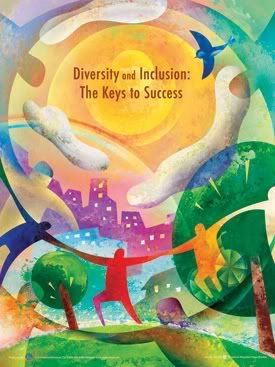
CollaborativeTeaching + Differentiated Instruction= Inclusion


A couple of things. First, I love your last picture! The different colors, sizes, and all of the different places that the figures are looking. It's very simple but it speaks volumes! Nice find--it's great!
ReplyDeleteAlso, I'm really glad that similar things seem to jump at us both from the reading. Normal is a really hard thing. I realize that in the context that we are speaking of, it refers to the intelligence and abilities of a child--however, I find myself needing to refer to it more often when I am speaking with a student who is searching for themselves and who they are. They come with questions like, "Why am I not like my friends?", "Why do I look different?", "Why am I not normal?" How do you tell a young person in that context that normal is simply conformity to the masses & we want them to be special. We want their personality and descisions to be special, but we want their learning style and classroom personality to be as "normal" as it can be. Where's the line?
--Ruthie B.
Hi Ruthie-
ReplyDeleteAfter I posted, I saw that we both were struck by that word, "normal". I will ask in class if it matters if we have some of the same content. I think it is telling, though, how we both wanted to include this in our blog. Even with the definitions, I still dislike the negative connotation it has as to conforming to society or standards.
Andrea